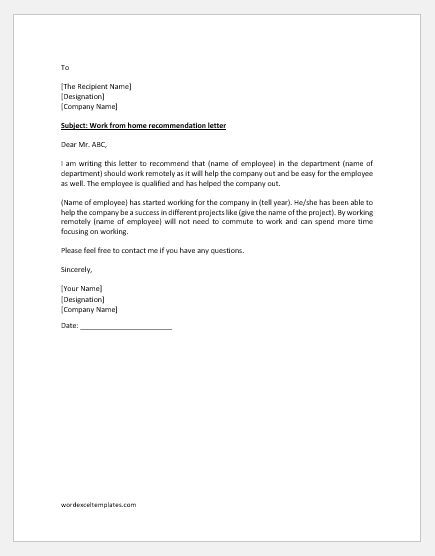
A work-from-home policy is a formal arrangement that clearly defines the responsibilities, expectations, and requirements for employees who work remotely. It may also explain the request and approval process, eligibility requirements, working hours, communication procedures, and performance expectations. A clear policy helps both employees and managers maintain productivity, accountability, and effective communication while working remotely.
The following is a sample work-from-home policy that can be customized according to an organization’s specific requirements.
Sample Policy
Objective
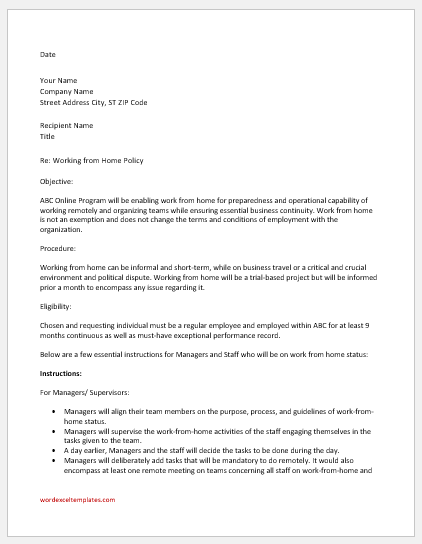
ABC Organization may allow employees to work from home to support operational flexibility, business continuity, and effective remote collaboration. Working from home does not change an employee’s existing terms and conditions of employment unless otherwise agreed in writing.
The purpose of this policy is to establish clear guidelines for employees and managers regarding remote work arrangements and to ensure that business operations continue efficiently.
Procedure
Work-from-home arrangements may be short-term, occasional, or scheduled, depending on operational requirements and individual circumstances. Remote work may also be permitted during business disruptions, emergencies, travel-related situations, or other circumstances in which working from the office is impractical.
Where appropriate, a work-from-home arrangement may initially be introduced on a trial basis. Employees will be informed in advance whenever possible so that any technical, operational, or scheduling issues can be addressed before the arrangement begins.
Eligibility
Employees requesting or selected for a work-from-home arrangement should generally:
- Be regular employees of ABC Organization.
- Have completed at least nine consecutive months of employment with the organization, unless an exception is approved.
- Have a satisfactory performance and attendance record.
- Hold a position that can reasonably be performed remotely.
- Have access to the equipment, internet connection, and communication tools necessary to perform their duties effectively.
The following guidelines apply to managers, supervisors, and employees participating in work-from-home arrangements.
Instructions for Managers and Supervisors
- Managers should ensure that team members understand the purpose, procedures, and expectations associated with working from home.
- Managers should assign and monitor tasks for employees working remotely and provide appropriate guidance and support.
- Whenever practical, managers and employees should agree in advance on the tasks and priorities to be completed during the remote working day.
- Managers should schedule appropriate remote activities, which may include team meetings, individual meetings, responding to emails, preparing reports, and completing other job-related responsibilities.
- Managers should use the organization’s approved communication and collaboration tools for meetings, scheduling, and team coordination.
- Managers should remain available to address work-related questions and provide assistance when required.
- Where appropriate, managers may conduct a follow-up discussion with employees to review their remote work experience, productivity, challenges, and any improvements that may be required.
Instructions for Employees Working from Home
- Employees should remain available during their agreed working hours in the same manner as they would when working from the office, unless otherwise approved by their manager.
- Employees should ensure that they have access to the necessary equipment and resources, such as a computer, reliable internet connection, telephone, and required software.
- Employees are responsible for completing assigned tasks and participating in scheduled meetings and other work-related activities.
- Employees should remain reachable through the organization’s approved communication channels during working hours.
- Employees should work from their approved remote work location unless an alternative arrangement has been authorized.
- Employees are expected to maintain the same standards of professionalism, confidentiality, productivity, and information security that apply when working from the office.
- Any technical problem or other issue that significantly affects an employee’s ability to work should be reported to the appropriate manager as soon as possible.
Review and Feedback
Following a trial or temporary work-from-home arrangement, managers and employees may be asked to document and share their experiences, challenges, and recommendations with the appropriate department or designated contact person.
The review may address the following:
- What worked well and what could be improved.
- Any significant challenges or limitations encountered.
- Communication and collaboration effectiveness.
- Technical or equipment-related issues.
- Recommendations for making future work-from-home arrangements more productive and effective.
Approval and Assessment
Before approving a work-from-home arrangement, the HR Department and the employee’s manager may assess the suitability of the employee and the position for remote work. This assessment may consider the employee’s job responsibilities, performance, required equipment, information-security requirements, communication needs, and other relevant operational factors.
All approved work-from-home arrangements remain subject to the organization’s policies, employment terms, confidentiality requirements, and applicable workplace procedures.